Mosaic
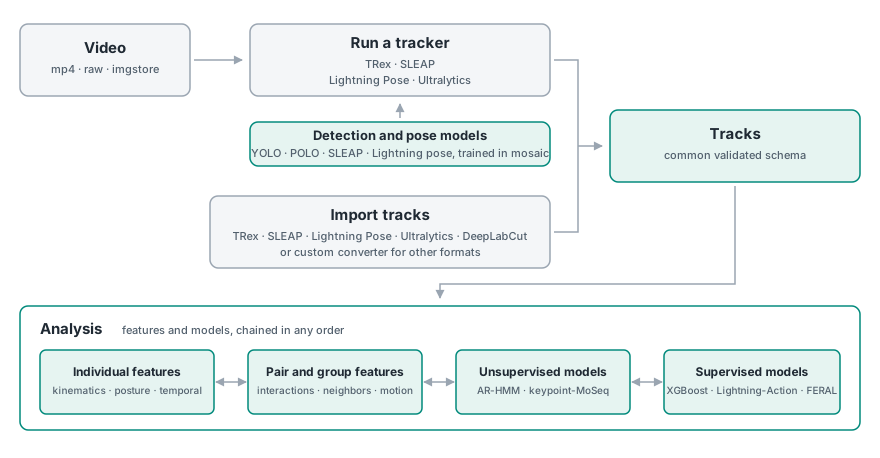
A Python toolkit for end-to-end animal behavior analysis: video processing, pose estimation, track standardization, behavioral feature extraction, model training, and visualization.
For an introduction aimed at researchers, see the project README on GitHub. This site is the developer-facing reference: how the pipeline is structured, how to add features, and the API.
Package structure
src/mosaic/
├── core/
│ ├── dataset.py # Dataset orchestrator
│ ├── pipeline/ # Feature execution engine + typed protocol
│ ├── schema.py # Track schema validation
│ ├── analysis.py # Clustering metrics
│ ├── helpers.py # Label loading, safe name encoding
│ └── track_library/ # Track format converters (CalMS21, MABe22, TREx)
├── behavior/
│ ├── feature_library/ # ~30 registered feature implementations
│ ├── model_library/ # Legacy — being phased out (see repo summary)
│ ├── label_library/ # Label converters (BORIS, CalMS21)
│ └── visualization_library/ # Overlay, playback, egocentric crops, timeline plots
├── tracking/
│ └── pose_training/ # YOLO pose, POLO point-detection, localizer heatmap training
│ └── converters/ # CVAT, Lightning Pose, COCO format converters
└── media/
├── video_io.py # Video I/O with raw H.264 fallback
├── extraction.py # Frame extraction (uniform / k-means)
└── sampling.py # Frame selection algorithms
High-level workflow
Data flows through the Dataset orchestrator (everything is versioned by run_id):
video files
│
├─ index_media() → media/index.csv (ffprobe metadata)
├─ extract_frames() → media/frames/ (uniform or k-means sampled PNGs)
│
raw tracks/labels
│
├─ index_tracks_raw() → tracks_raw/index.csv
├─ convert_all_tracks() → tracks/<group>__<seq>.parquet (standardized)
├─ convert_all_labels() → labels/<kind>/<group>__<seq>.npz
│
└─ run_feature() → features/<name>/<run_id>/*.parquet
per-frame: speed-angvel, pair-egocentric, nearest-neighbor, ...
spectral: pair-wavelet
reduction: pair-posedistance-pca
context: temporal-stack
templates: extract-templates, extract-labeled-templates
global: global-scaler, global-tsne, global-kmeans, global-ward
trainable: xgboost, arhmm, feral, kpms, lightning-action,
global-identity-model
visualization: egocentric-crop, viz-timeline, viz-global-colored,
interaction-crop-pipeline
Core concepts
Dataset
mosaic.core.Dataset is the central orchestrator. It manages named roots (media, tracks_raw, tracks, labels, features, models) and provides methods for every pipeline stage. Manifests are YAML or JSON.
from mosaic.core.dataset import Dataset
ds = Dataset(manifest_path="path/to/dataset.yaml")
ds.load()
Features and global features
Everything in mosaic is a feature, registered via @register_feature. Each feature implements a 4-method protocol (load_state, fit, apply, save_state) plus a few attributes (name, version, parallelizable, scope_dependent).
Two flavors:
- Per-frame / per-sequence features — stateless transforms of tracks or upstream feature output.
- Global features — trainable, fit-then-apply features that learn from a collection of sequences (or labeled examples) and then map per-sequence. This is where mosaic's "models" live.
| Category | Examples |
|---|---|
| Per-frame kinematic | speed-angvel, body-scale, orientation-rel |
| Per-frame spatial | pair-egocentric, pair-position, approach-avoidance |
| Per-frame social | nearest-neighbor, ffgroups, ffgroups-metrics, nn-delta-response, nn-delta-bins |
| Track preprocessing | trajectory-smooth, movement-smooth, movement-filter-interpolate, pair-interaction-filter, id-tag-columns |
| Spectral | pair-wavelet |
| Reduction | pair-posedistance-pca |
| Context | temporal-stack |
| Templates | extract-templates, extract-labeled-templates |
| Global (trainable) | global-scaler, global-tsne, global-kmeans, global-ward, xgboost, arhmm, feral, kpms, lightning-action, global-identity-model |
| Visualization | egocentric-crop, viz-global-colored, viz-timeline, interaction-crop-pipeline |
See the Feature Library API for details.
Run IDs and reproducibility
Every feature run is tagged with a hash-based run_id (<version>-<SHA1(params)>). Outputs live under features/<name>/<run_id>/. Feature params are captured in params.json. Identical params + identical inputs always produce the same run_id, so re-running is a no-op and parameter sweeps stay organized automatically.
Installation
conda create -n mosaic python=3.12 -y
conda activate mosaic
conda install -c conda-forge ffmpeg -y
pip install -e ".[recommended]"
The recommended bundle covers the typical research workflow (wavelets +
YOLO pose + PyTorch localizer). See the project
README for the full
extras matrix and notes on the mutually exclusive pose / polo ultralytics
pins.