Guides
Media
| Guide | For |
|---|---|
| Prepare and index your media | Indexing, transcoding, imgstore, frame extraction, calibration |
| Pre-process media for a tracker | Cropping, masking, trimming and adjusting video into a variant that a tracker reads |
| Render an annotated video | Drawing tracks, identities and behaviors back onto the recording |
Declaring a media source and scanning it is dataset setup — see The mosaic dataset.
Tracking
| Guide | For |
|---|---|
| Import tracks you already have | Something else did the tracking, and you have the files |
| Run a tracker | You have video, and one of four integrated tools can track it |
| Train a pose model | No off-the-shelf model works on your animal |
| Write a converter | Your format is not one mosaic already reads |
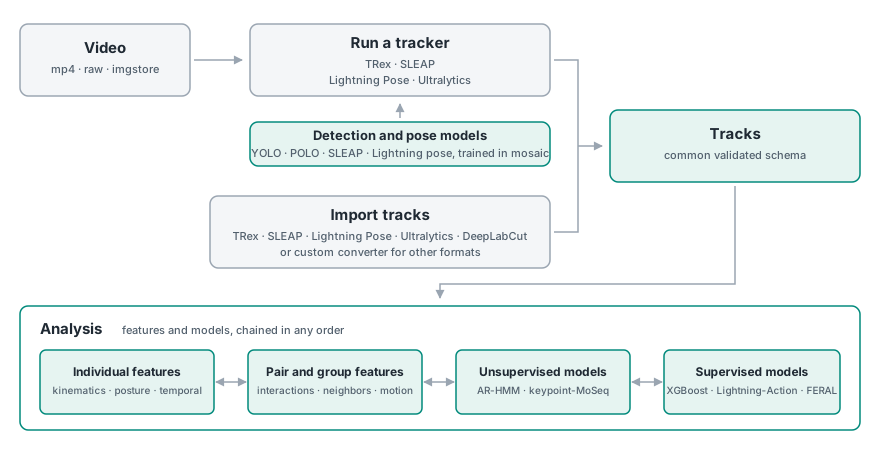
Every tracks table is video pixels with X/Y at the body center, whichever tracker
produced it. What a tracker reports covers the units, and why
a tracker may not give you a speed.
Analysis
Everything computed from tracks is a feature, and there are five kinds. Per-frame features put a value on every row — kinematics, heading, neighbors, pair geometry. Global features are fitted once across many sequences and then applied — scalers, t-SNE, AR-HMM, keypoint-MoSeq, VAME, the classifiers. Summary features reduce many rows to few. Media features write an image or video that something else reads, such as an annotated overlay. Tag features add identity columns. All five run and cache the same way, which is what lets them chain.
| Guide | For |
|---|---|
| Features | What the library holds and how to run one |
| Import behavior annotations | You have BORIS or CalMS21 annotations to bring in |
| Find behaviors without labels | Embedding, clustering and state models |
| Train a behavior classifier | You have labels and want predictions on the rest |
| Identify individuals by appearance | Recovering identity from how an animal looks |
| Write your own feature | The library does not have the quantity you need |
Pipelines
Everything that mosaic does can be composed into a pipeline, which is a step-by-step processing recipe that includes the parameters used. For example, features can be chained together to define an analysis pipeline.
| Guide | For |
|---|---|
| Chain steps into a recipe | Composing steps, in a notebook or as a portable file |
| Run work and see what ran | Executing, scoping, and reading the outcome |
| Keep a dataset organized | Inventory, re-indexing, and reclaiming space |